Last week I had the opportunity to attend our Superconference during our Pro-D day and the keynote speaker was Mike Jones, the head coach of the famed DeMatha High School. He spoke on a number of topics, including his favorite practice drills, his man-to-man teaching progression, and the DeMatha version of the flex offense.
It starts out just like every other flex offense, like the Gonzaga, Boston College, or Maryland. They are 4 around 1, and the post sets a flex screen for the guard who flex cuts towards the ball,

This is where the DeMatha flex differs from others, instead of a downscreen, they set upscreens. O2 looks for O4 off the UCLA cut. O5 sets a flare screen for O1 who flares out to the other side.

If O4 is not open, then he goes and sets another upscreen for O5 who cuts to the low block and looks for a post-up.

Then the continuity goes again to the other side.

In addition to the main flex continuity they have, they have also added the following variations:
- they like the upscreens because once those guys go up to set those screens, the wing player always has the option to take his man off the dribble and get into the lane because everything is opened up with those 2 players setting upscreens.
- The top player can dribble/replace with the wing player if the wing is overplayed on the initial pass from top to wing
- The top play can always go backdoor if being overplayed on the reversal from wing to top
- After the ball is reversed from wing to top, if the wing player is being overplayed, the flex cutter can set a backscreen for the wing player and the top player can hit him going to the basket.
Finally, if you want to see a little video of it, here is some from Youtube, but you can't see the whole continuity, you'll have to buy it here to see it all,
Going through some more videos the other day and really enjoyed UNC women's head coach Sylvia Hatchell's Quick Break DVD. It's not a great DVD if you're new to coaching and looking for the encyclopedia on offense. But for more experienced coaches, she's got some great tidbits in it.
One of the best parts is where she explains her 2-rule motion offense. Very simple to use, and suitable for any level of play. Much easier in my opinion than a traditional flex, or swing, or open-post motion. But sophisticated enough to run all the way up to the college level.
The 2 rules to the offense are:
1. Guard to Guard pass - Downscreen
2. Guard to Wing pass - Cut and fill
The post player just follows the ball to the side where the ball is.
That's it. Simple. The crux of the offense lies in the reading of the downscreen. There are 4 things you can do off of the downscreen - pop, curl, backcut, flare. 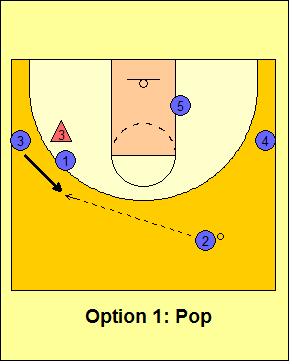


This is the part where you really need to drill your players, on how to read the defender off the downscreen. If the defender cuts underneath, then you pop out. You can then drive into the middle or shoot the mid-range, or shoot the 3-pointer. If the defender chases, then curl to the basket. If the defender jumps over the top to deny the pop, then backcut. If the defender cuts underneath and gets in a position to stop penetration, the screener rescreens for the flare cut.
It's also a great offense to use up some clock, you get good movement and there are other options you get use such as the post coming up to ball screen, it's an easy offense to fast break into. Really easy to teach, and something you can even add if you already do something like dribble-drive and you want something where players off the ball are moving more. I haven't seen the Kevin Boyle's Motion Offense DVD but I've heard that the rules are very similar.
Hope you all are having a great summer, it's hard to believe that there's only a few weeks left, the basketball season will be sneaking up on us pretty soon, enjoy the summer while you can.
Bobby Knight on the Dribble Against Zone and Man Defense
Posted by bruchu Labels: Drills, Motion Offense, Zone Offense
Downloaded some great notes the other day which cover Bobby Knight's DVD on Practice Planning and Drills (notes created by coaches at Springs Valley Blackhawks). One interesting tidbit that I thought I would share is Coach Knight's philosophy on the dribble, against zones, and against man. He says that the dribble is the most effective against the zone, and against man he is straight motion. An extract:
Four Possessions
- Inside man should be the screener
- Do not throw the ball to the corner
- Talk about balance to your players…get the ball off the baseline…don’t crowd baseline!
- Players have a tendency to resort to the dribble vs. man, but Coach Knight actually encourages the
dribble against a zone
o Dribble against a zone every time that you catch the ball on the perimeter
o Attack a seam
- Causes the top defenders to react and move
- Dribble does more to change a zone than anything…it forces it to become something that it does not want to be
Man Offense: Eliminate the Dribble (No Dribble Drill)
- This drill develops cutting and spacing as well as encouraging good passes
- Players should only dribble to change position or to get to the basket
- Teams develop confidence that they can score without putting the ball on the floor
- Man/Man D…three-point line is the last line of defense for picking up the ball
o Half-court is the farthest
o Point of pick-up is dictated by how quick you are and how quick the offense is
- Post players need to hold their posts…don’t come off the block
o Other players do not come into areas where a post man is holding a post
- Don’t just run around…SEE AND REACT
- Offensive players need to get off the baseline
- No cross court passes against man-to-man defense
Traditionally, the idea against the zone is that you move the zone with the pass, by quick reversals and skip passes. But I've used the dribble in the past to great effectiveness against a zone as well, so I think there is a lot of merit to this idea. As for against man defense, I can see Coach Knight's point about over-dribbling, but the dribble penetration is still the hardest thing to stop for the defense.
In watching some local playoff games the other day, I caught one game where one team's M2M help-recover defense was causing the other team's motion offense all kinds of problems. When it comes to the playoffs, it's all about the adjustments, everyone knows what everyone else is running, so the ability to make subtle but important changes is crucial.
I came across these great notes from a coaching clinic conducted by Coach Bad Brownell that outlined some great adjustments you can make to your motion offense against a strong help defense team. In watching that playoff game, I thought a couple of tweaks could have helped them overcome their difficulties:
Motion Ideas vs Helpside Defense
General thoughts - move the defense:
- Ball reversal
- Player Movement
- Early Offense, flow into motion acting out of transition
Flare Screens
Use flare screens because the defense usually jumps hard to ball (over-committing) when playing help defense,
Screen and Skip
Screen in for the crosscourt pass, then skip to the open side. The side to side action really causes help defense teams a lot of problems, just like it does for zone defenses,
Downscreen Cutters
Pass and cut on the perimeter. Cutter cuts through the basket and receives a weakside downscreen by the offensive player on the weakside, then you can reverse the ball quickly to that open cutter,
Drive the Weakside
On the quick ball reversal or skip pass, your perimeter players need to attack the glass as defenders are temporarily caught on help rotation,
Penetrate and Fill Behind
Drive hard at a shooter's defender, and the shooter should fill behind for the open shot. Basic drive and kick principle,
For more info on drills to use for motion offense like the dribble drive, take a look at John Calipari's DVD on Perimeter Drills for the DDM. Coach Calipari is the head coach of the University of Kentucky Wildcats.
Was looking for more motion offense ideas for a coaching friend and came across these great notes from a coaches clinic with Villanova's Jay Wright breaking down some of the intricacies of their Wildcat Spread offense. The whole key as you've probably guessed is spacing, anyways, enjoy...
Positions on the floor
1. Two Baseline spots directly in line with the block
2. Two slots perimeter position, two feet off of the lane line extended
3. 18 feet separation between slots and baseline position
4. Post man “prime time” post position above the block, allows for cutters and room to operate for post
Perimeter players
1. Three Perimeters can fill any of the three perimeter positions
2. Dribble through fill each of the four perimeter spots
Post Players
1. Can fill either post position or either slot position
2. Must always be diagonal from each other
3. One post player is in the slot and one is in the perimeter.
*SPACING AND TIMING ARE VERY IMPORTANT
Basic Rules in Motion
1. Post players should always be high and low in the offense
2. Screen the guard to the maintain the opposite spot
3. Our post players always screen the man in the slot
4. Ball is in the slot, ball screen
5. Ball is passed to the baseline position big man set the flare screen
6. When the ball is in the slot with the post the big man will look to duck in
7. When the ball is passed to the post the opposite big man will rip or dive to the opposite post
Rules for Perimeter Players
1. After any pass guards can basket cut
2. After any pass can receive a flare screen
3. After pass guard can down screen
4. NEVER PASS AND STAND
5. Our perimeter players always screen for each other
6. Use dribble to drive or make an easy pass
Key Teaching Points in 4 out 1 in motion
1. Post Ups and ball screens are our primary looks
2. Any time a guard gets a ball up top looking for post up or running a screen and roll with the slot man post
3. Set a ball Screen in the corner sets up action on weak side
4. Post entries set action up
5. All people on the perimeter must look like a shooter
6. Get your eyes on the rim
7. Use good shot selection (take easy shots)
8. Be “solid” Make the proper fundamental play
9. Take lanes - do not fight the defense
10. Communication
11. Read Opposite
Scoring Opportunities in Motion Offense
1. Post Up and Rip (ball goes in the post opposite post goes to the basket) Other guards space the floor and three goes to the opposite elbow
• Post, Rip and Skip for jumper
• No jumper we post, rip, skip and seal the rip man
2. High Ball Screen
• If on a drag dribble screener makes a basket cut while opposite post fills slot position
• Baseline guards will space to the corner to spread the defense
• Guard curls post will space and opposite space will space below looking for cut opportunity
• Roll Pop and Seal (drag and hit the post coming in the slot, the post man in the prime time spot will then look to a seal in the high low duck in look).
3. Screener, cutter situations
• Four and five man are screeners and second cutters
• Ball to the corner post sets a flare screen
• Screen, curl, and pop for second cutter
4. Side Ball Screen
• Staggered double on the weak side to occupy the defense
For more on Coach Wright and Villanova's motion offense, then check out Jay Wright's DVD on Drills for his 4-out 1-in Motion Offense. The Villanova Wildcats are currently ranked 4th in the latest AP Poll.
Going through some more notes this weekend and specifically I was looking for information on dribble penetration in a 4-out 1-in. From the dribble drive offense, you setup with the 1-in post always on the weak side. But I don't think it's always realistic to expect that in a game situation that will always happen. From these fantastic set of notes compiled by Zak Boisvert, here are some general penetration rules you can use for any 4-out 1-in motion offense, this is taken specifically from Rick Majerus and his 4-out 1-in motion.
Baseline drive on an empty post:
Nearside high elbow (O4) cuts behind for crackback (should be man to a man and a half behind ball). Farside high elbow (O2) drifts to vision (“It’s not a spot. It’s a “can the driver see me with his eyes?”). O1 sprints to corner for drift. O5 diagonals up to the front of the rim right by the front of the rim and should look to attack, but can settle for soft jumper (no bounce passes made to this big - everything going to O5 in this situation should be a chest pass — conversely a bounce pass on the baseline drift pass O3 to O1 because it’s extremely tough for v-back man defensively to get his hand down when covering sideline).
If such a baseline drive were to happen while a stagger was being set, the first screener (O2) would head to drift spot on first sign of penetration. The second screener (O4) who had taken a step towards stagger circles for crackback. O1 would “drift to vision.”
Middle drive on an occupied post:
(Perimeters should never be afraid to drive an occupied post. It’s their job to get out of the way). O5 would move foot closest to driver (right foot in diagram) and turn his body momentarily to head to baseline. O5 would turn to open and
call O1’s name (must make a verbal call).
Baseline drive on an occupied post:
O5 makes space by again lifting the foot the perimeter is driving at (left in diagram) and runs to the midpost area, curling to face O2. O5 should again make a verbal call and if O2 does throw this pass it should be a hook pass. On O5’s catch: shot (if he can shoot it) or a dribble handoff/pass to the nearest perimeter followed by an elbow angle ball screen (run a flare on opposite side—who’s going to help?)
For the complete explanation of this motion offense, take a look at Rick Majerus' 3-set DVD on the Encyclopedia of Motion Offense. Coach Majerus is currently the head coach of St. Louis.
Michigan Backdoor Lob Out of Open Post Motion
Posted by bruchu Labels: *NCAA, Motion Offense, Offensive SkillsI'm a big motion offense coach myself so anytime I see teams execute motion offense well, it puts a big smile on my face. The Michigan Wolverines under John Beilein have become a big motion team. Coach Beilein has brought his open-post motion over from West Virginia, and after a couple of years of finding the right the players, the Wolverines look like they're back to contend for final fours again.
In this play in OT against Creighton, the Wolverines execute the backdoor lob to perfection. Setup is high-post open motion. 4 players on the perimeter, forward at the high post. The forward pops outs to receive a pass for what would normally be a ball reversal to the side of the floor. This is the most crucial part for any motion offense. Players must setup their cuts. If the forward simply cuts backdoor here, it won't work because the defender starts in position to guard against it. The forward must really plant his top foot and use his hands to indicate he is ready to receive the pass up top,
The defender bites and overplays the ball reversal pass. This is where eye contact and communication between ball-handler and player are crucial. Both players realize the overplay right away, the forward plants hard of the top foot and uses his lateral quickness to go backdoor,
The ball-handler sees it and looks to lob the ball to the forward guiding him to the rim,
What seems like a simple play, actually takes many many reps and whole-part-whole progressions to teach. It's important to remember that motion offense takes time and you must be patient to teach it. You can't expect to put it in late November and expect your players to win the season opening tournament. It literally takes hundreds of reps in multiple situations before players get used to how and when to do what, and to get used to their teammates. But once they get it, motion offense is the most beautiful thing to watch, it's basketball offense at its purest.
Coach Beilein doesn't have any DVDs produced but if you're a fan of motion offense like me, then check out Bobby Knight's new DVD on motion offense. The DVD includes 2 hours worth of motion wisdom from the legendary college coach.
I was talking online with a coaching friend from Washington State the other day and we got into a debate about the pros and cons of the shot clock. My personal opinion is that shot clocks in general are a good thing because they encourage more flow in a game. But I can see my friend's point in that the use of a shot clock gives the advantage to teams that have superior athleticism, teams like his can run a delay offense to dictate tempo and offset the athletic gap with superior passing, patience, and shot selection.
I went through some more notes today and came across some notes on the offense used by the University of Tennessee Women's team, coached by Pat Summitt. I don't know if Coach Summitt has used it in the past few years, but I've seen some older footage where they did use it. It's a 5-out continuity offense which you could definitely adapt to use as a delay offense. It is slow developing and you probably would run it 3 or 4 iterations before getting a good defensive breakdown to take advantage of.
Setup
It's a basic 5-out set. Since it is a continuity, numbering is not all that important and all players are interchangeable. It really doesn't matter who is where, so long as they run the pattern correctly. The point guard, O1, dribbles into the middle of the floor at the top of the key. O2 and O5 are spread at the wings and O3 and O4 are at the corners to start. O1 passes to the right wing and cuts to the wing while O5 replaces,
O2 reverses the ball through O5 to O1 on the other wing. This is to create initial movement and to setup the cuts to follow,
Basket Cut and Downscreen
2 really basic basketball plays. First, the weakside wing, O2 here, does a straight basket cut. If open, O1 hits O2 going to the basket for a layup. If not, O2 begins to clear out to the same side. As O2 makes the basket cut, O5 begins to move towards the lane, O3 starts to move up,
O2 clears to the corner. O5 sets a basic downscreen on air, O3 sets up the cut going to the basket but then coming over top of the screen. O5 reads the play, if the defense hedges, O5 can roll to the basket for a quick hit. If the defense is underneath, pops back out. O3 comes to the top of the screen looking to receive a pass from O1. O3 can then reverse to O5 up top or down to O5 posting up or going to the hoop,
Repeat On Other Side
The action repeats on the other side. This time, O5 is the passer and O1 is the cutter,
O3 goes to set the downscreen this time for O4. Same as above, just different players and different side. If nothing is open, the action repeats back to the right side of the court,
A very simple 5-out continuity, but I think it is good because if executed properly and patiently, it can result in high quality shot opportunities. If you want to learn more about the Tennessee way, then check out Pat Summitt's DVD on Game Preparation.
A coaching friend of mine coaches a group of U13 players in a youth league here in the Greater Vancouver area. He asked me for some advice a couple weeks ago because he was having some problems on offense with his team. He had been using the Backdoor Trap continuity offense and it had been working OK, but he said the problem was that it got worse and worse as the game went on. I actually had never heard of the Backdoor Trap offense before so I had to look it up.
I went to one of their games and after awhile I could see what the problem was. As the game progressed, the offense was still being well-executed but the defense naturally began to anticipate the backdoor flex cuts. This in itself wasn't the problem though, because at U13 most players never get used to defending the backdoor cut, they're always ball watching. The real problem was spacing. Because 4 players were playing inside of the 3-point line, the defense simply contracted such that the possibility of making any successful backdoor pass was nearly impossible:
I went back home and drew up a modification to the Backdoor Trap offense, that I call the 4-out 1-in Motion Backdoor Trap Continuity Offense. It is essentially, the same continuity but with better spacing and incorporating some DDM and other motion principles. So it's not really true motion, DDM, or Backdoor Trap, but a combination of all of them. I gave it to my friend to use and he's saying it's helped them alot, the extra spacing gives them a lot more options and forces the defense to stretch and cover.
The setup of the offense is 4-out 1-in. The wings can start below or above the free-throw line extended. They should v-cut or l-cut to the ball though and receive it above the free-throw line. The post should play opposite of the ball for spacing. The first play should be a wing pass and the point cuts to the ball-side corner. The other top player (02) shifts over ball-side as the safety.
This is where the main action takes place. The post (O5) goes to set a wing-flex backscreen for the wing (O4). If O3 can take his defender off the dribble, he does so. If O1's defender comes to help, O1 should be open for the corner 3-pointer. As O3 drives, or even if O3 does not, O4 should be coming off the backscreen and if open O3 can hit him for the open layup. O5 pops out to the wing after the backscreen,
If O3 does nothing with the ball, the ball is reversed to O2 up top, O5 comes up to receive the ball (v-cut or l-cut) and O2 cuts to the ball-side corner after the pass,
In this sequence, the action repeats from the left side of the floor. As an option, if O4 has a favorable post matchup, O5 can make a post entry here for a 1v1 post up for O4. Otherwise, O1 clears out from the weak-side corner and comes up as the safety. O4 clears out to the weakside and sets a wing-flex backdoor screen for O3. O5 should dribble drive if possible. All the way to the rim, to O2 on help defense, or to O3 on the backdoor just like previously on the right side of the floor,
I just wanted to show this final sequence because you can incorporate any of your regular motion cuts and ball screens using audibles from the bench or from your PG. For example, after passing to the wing, the point can set a ball screen for the wing and play PNR. Or on the weakside wing, the wing can fake the backdoor and instead come over the top for the elbow jumper. Basically, anything you normally teach in 4-out 1-in motion can be used here,
Hope that helps out with you coaches out there looking for a little variety in your flex, motion, or halfcourt sets. For more motion and backscreening ideas, take a look at Matt Painter's 4-out 1-in Motion Offense. Coach Painter is the head coach of Purdue.
Found some good handwritten notes from a coaches clinic retreat several years ago where Coach Steve Alford, currently the head coach of New Mexico, talking about his 3-in 2-out motion offense (Download the video clip here). In my opinion, it is similar to the blocker-mover motion except it uses the 3-point line as the delineation instead of designating roles. I've inscribed them below:
1. 3 in, 2 out motion. The '3 in' players use the college 3 point line and 'in' as their domain. The '2 out' players use the above the college 3 point line and 'out' as their domain.
2. The '2 out' players can only become one of the '3 in' players if they are backscreened by a '3 in' player. Otherwise, the '2 out' players should be positioned above the college 3 point line.
3. The first screener always receives a screen after setting one.
4. The '2 out' players must be able to react and pass. If pressured, and as the '3 in' players move, driving opportunities will exist for these 2 players.
5. Breakdown drills '3 in' players play '3 on 3' live with the '2 out' players passing without defense. The '2 out' players play '2 on 2' live with the '3 in' players going 3 on 0 -- no defense. The '2 out' players work on getting open.
To learn more about the 2-out 3-in motion that New Mexico runs, take a look at Steve Alford's DVD on the 2-out 3-in Motion Offense.
Reading the other day that Dave Leitao was being linked to a head coaching job in the NBADL, specifically with Rio Grande Valley, it had me thinking about his 32 motion offense and what went wrong there in Virginia. In my opinion, the offense is simply too complicated. But maybe I'm wrong. You can be the judge, here are some notes and diagrams of what I've been able to reconstruct of the 32 motion offense,
According to Leitao, the goal of the motion offense is "you want have an offense that has control and some freedom." The problem though is that motion offense is very good for really skilled players because you can trust them, or very bad for unskilled players because you can't limit them. The offense is based on a series of cuts and stagger screens, attempting to take advantage of mismatches. Forwards are mostly blockers setting screens but also ducking in looking for post-up opportunities. Guards are coming off screens looking for open shots. You can run it as a one and done quick hitter or delay by repeating the motion over and over. The five basic cuts are:
1) Away
2) Corner
3) Chase
4) Swing
5) Shuffle
Away
The idea of the away cut is to run a wing player through the lane. O1 can dribble to or simply pass to the wing, then cuts to the opposite wing. The opposite forward comes up while the opposite wing cuts through the lane looking for the ball, then clears out to the corner,
O2 reverses the ball to O4 then to O1. O5 sets a short UCLA screen for O2 who uses it to cut over top and through the lane looking for the ball,
If neither cut is open, then O4 and O5 set a stagger screen for O3 in the corner. O3 comes off both screens, O1 looks for O3 for the open 3-pointer,
O5 and O4 set another stagger screen this time for O2 who settles into the opposite corner. If O3 is not open, he can dribble/pass to O2 in the corner for the 3-pointer,
Corner
In the corner cut, the guard at the top cuts to corner, same side as the pass to the wing. The goal is to setup a good post-up for O4. O5 comes up to the top of the key,
As the ball is reversed from O3, to O5, to O2, O4 goes block to block looking for a good duck in or post-up,
If O4 is not available, the offense goes into a stagger screen, O3 and O5, for O1 who comes over the top of the stagger and receives a pass from O2 for the open 3-pointer,
Chase
The idea of the chase is like the fill in the DDM. When O1 dribbles towards the wing, O3 shuffles while O2 trails and fills up top. O1 passes to the trailer O2, then O4 comes up to set a screen for O1 who locates on the wing,
There are a series of screens by forwards for guards, O5 sets a baseline flex for O3 looking to curl into a mid-range jumper. O4 screens for O1 coming over the top for an open 3-pointer,
Swing
In the swing, the idea is to get the defense to chase. O1 passes to the wing, O5 sets a UCLA screen, O4 sets a baseline flex, and O3 makes it a stack screen. O1 goes through all the screens and comes out the other side. O2 can dribble/pass to O1. If O1's defender goes over top, then O1 can flatten out for the open jumper in the corner. If O1's defender trails all screens, then O1 should be able to come up to the free-throw extended for an open jumper. If the defense switches everything, then O4 and O5 should have mismatched post-up opportunities,
If nothing develops, O5 steps out to set a ball screen for O2 to drive for the open mid-range or dump-off if help comes,
Shuffle
The shuffle cut is your basic cut for spacing. As O1 dribbles towards the wing, O2 shuffles down. O5 comes to set a mini-flex baseline screen for O2. O4 comes up to receive the pass form O4 and O3 flattens out,
The next two sequences are just flex downscreens to setup both 3-point opportunities and reverse seal post-ups,

If you are intrigued and want to learn everything there is to know about the 32 motion offense, then check out Dave Leitao's DVD on the 32 Motion Offense.
Like all offenses, there are many different versions and variations based on how coaches have tweaked it to fit their needs. The Maryland flex offense under Gary Williams is one such variation of the generic flex offense. I like the flex offense a lot and I've used it in a few different situations in the past. The key to the flex is teaching proper screening and movement off the ball. It may not be as dynamic as the DDM, but I think the flex is a structured offense that will get good shot opportunities. Here are some more tips from Coach Williams himself talking about the Maryland flex at a Nike coaches clinic:
- "If you can’t screen, you can’t score. Anytime you set a good screen, you are dangerous."
- "Offense must get the ball inside to shoot free throws and it tests the defense to see how tough they are."
- "You need guys that can catch and pass."
- "Must enter the pass to the post from the wing on a bounce pass."
- "We don’t down screen cause that makes the flex into a jump shooting offense."
- "The duck in move is like bowling you need to pick up a couple extra pins."
- "The 3rd cutter is usually open in the flex."
As mentioned above, the main difference between the Maryland Flex than say the Gonzaga flex or the Boston College flex is that Williams doesn't believe in down screening. I personally like the downscreen because it does usually open up a good shooting opportunity, but I can see Coach Williams point about player settling for the outside shot instead of looking inside.
Maryland Flex:
So, essentially, this is what the offense looks like. They like being in 4-out 1-in, with a dominant post player. O5 goes to set a baseline flex screen for O3 from the corner who goes low side. This allows O5 to pivot and duck-in looking for the quick hit. As Coach Williams mentions above, make sure your post is really moving bodies down low, play big. O1 passes to O2 from side-to-side to gain a better passing angle,
Now, if the defense starts cheating with X3 taking off well before the screen or another common defensive tactic against the flex is to switch all screens, then O3 fakes to use the baseline flex screen and instead comes back to the ball for a 3-pointer, or a post-entry into O5,
I didn't go ahead and diagram the continuity but you can do any number of things to get from point-to-point. You can have everyone rotate from right to left, and restart the baseline flex from the left side. As Coach Williams mentions above, the baseline cutter usually gets open on the 3rd cut, so be patient with the offense.
If you really want to learn all the nuances of the Maryland flex, then you really need to take a look at Gary Williams DVD on the Flex Offense. Coach Williams is the long-time head coach of the Terrapins.