Showing posts with label Presses and Traps. Show all posts

It's the eve of the NCAA tournament 2013 edition, and I realize I haven't posted in a long while. Seeing that is Spring Break for me, I thought I should post who I am rooting for this March Madness. My heart is still with Bill Self and the Jayhawks, but this year I find myself rooting for Jim Larranaga and the Miami Hurricanes. Coach Larranaga is a basketball coach through and through, he's a big practice guy and still comes from the "defense wins championships" mentality that I see lacking in a lot of basketball play over the past decade or so.


I'm a big fan of Larranaga's scramble concepts and the teams that I've helped coached used all or part of them quite a bit. But it looks like this year, they are not so much forcing turnovers, but limiting opponent possessions (through great defensive rebounding) and keeping opponent FG% low. I haven't had a chance to watch a lot of Miami games, but I would bet that his camouflage defense is more prominent this season with the longer athletic types he has this season.

But the best part of Larranaga's coaching method is his attention to detail. To plan all the practice details and to prepare the way he does is really the secret to his success. He writes everything down, and keeps detailed notes of goals and what needs to be done.

Anyways, I hope everyone enjoys the tournament. I look forward to see which teams get to last to the Final Four.

Since making the final four a year ago, Shaka Smart's VCU Havoc defense has been much discussed recently. More than anything schematic, it is really more of a philosophy and an attitude. Certainly it requires a certain amount of stamina to run this kind of defense, but when run properly it is very very effective. Enjoy this "Havoc" compilation from the 2011-2012 season,


Been going through a number of coaching clinic videos and DVDs recently and one of the common concepts that keeps coming up breaking presses and traps is the idea of having 3 passes available at all times -- sideline, middle, and behind.

You can use any number of sets, 1-3-1, 1-4 across, 1-2-2, but the idea is to always make sure you have those three passes available at all times, with one of the players cutting diagonally to become the new middle player and everyone else cutting and replacing. In Bruce Weber's Press Break DVD, he calls this "pistons",


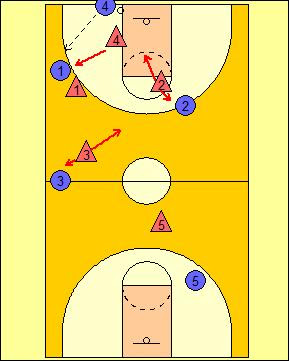
The idea translates to attacking half-court traps as well. The idea is you always want to present 3 pass options -- sideline (O3), middle (O4), and behind (O2). Lason Perkin's talks about it briefly in his Euro Ball Screen Offense,


Note above that the 4th player (O5) is always opposite the ball. This is for spacing as once the pass is made to one of the 3 options, you want to have a player on the weakside who is open for a quick reversal and layup.

In addition to this schematic concept of sideline-middle-behind, players need to know how to square up so that they can see the 3 passes and not throw the ball to a defender, and learn other concepts such as the crab dribble for pressure release which I've talked about earlier.

Anyways, hope everyone is enjoying watching basketball at the olympics. A devastating opening loss from the Team Canada Women's team against Russia, but they will come back today against England.

A lot of you probably have this press breaker in your arsenal against aggressive full court matchup or man presses, but if not, something interesting to consider. I was re-watching Billy Donovan's DVD on his Full Court Matchup Press the other day and one of the press breakers he talked about that gave them the most problems was the 1-4 across set. The wing players can really cause a problem because of the threat of the over the top pass,


What happens is if the defender, X5 or X3 in this case, is playing in a press coverage either inside or outside, they are highly susceptible to a quick v-cut and then a streak downfield for an over the top touchdown style football pass. You don't even need to v-cut, once the inbounder slaps the ball you basically break and you'll be wide open. If the inbounds is after a made basket, the inbounder can run the baseline and get an angle on either wing. If for some reason you can't make that football pass (bad timing, slow fowards, etc..), then O2 can cross screen for O1 and you can get into your regular press break.

Obviously after you burn the man-to-man press or matchup press a couple of times over the top, the defense will adjust by having the wings play over the top. They will still press the 2 inside players because the over the top throw is harder with the basket obstructing a high pass. But now you have a relatively open pass to the wing player, and your PG can use that to out-leverage the defender and streak as soon as the inbounds pass is made for the open pass,


So essentially, just by alignment, you have forced the defense out of a full press situation. If they decide to continue to pressure, they have to give each of your players a cushion. And by releasing all of your players down the court in a full sprint once the pass is made, you have effectively nullified their pressure. Sure, the X1 defender can still get up on your O1, they can try to trap with one of the other players, but you've allowed yourself the ability to get the ball in without pressure,

When I watch a lot of basketball at the lower levels (up to JV), it bugs me a little when I watch 1 team dominate the other team simply through a full court press. Ever since about a year ago, I used to be of the sole belief that it was just bad form for a more athletic team to FC press a less athletic team. But the more I think about it now, I think it points to a failure by coaches to properly teach players how to deal with traps and double-teams, especially in the open court.

There were always be situations where it is bad form for a team to be FC pressing (like if ahead by 20-plus points, etc...). But as coaches, we tend to overemphasize the tactical side, how to scheme out of FC pressure, and not actually teach players how to play out of pressure themselves. I think there are some general concepts we as coaches should be teaching which will allow even less athletic teams, the ability to successfully play against pressure defense in the open court. Sure it takes more work, there are no quick fixes, but in the end its a better way to approach it in my opinion.

I scoured my notes and came across some good teaching points from a Mike McNeill article of Basketball BC. So, without further ado, here are some of those great pointers:

1. Dribbling and passing skills required:
• Change of pace dribble
• Pop back or retreat dribble
• Pivoting skills – a great deal of passing ability is determined by pivoting ability; you must be able to create passing lanes by pivoting
• Pass fakes

2. With the ball, do not:
• Attempt to pass off the dribble over top of the defense
• Attempt to pass around the defense – “pass through the defense” - this means pass the ball by the ears, off the hips or directly over top of the defender’s head
• Pick up the dribble until you are ready – “keep the dribble alive”

3. Away from the ball, do not:
• Get “three in a row” – in the diagram O2 should move to the sideline, or to middle, to create a passing lane for O1
• Wait for the pass - move to the pass, “run through the ball”
• Let the defense catch up to the ball after a trap – Hit the next open player.


4. With the ball:
• Pass first, dribble second
• Fake high, pass low or fake low, pass high
• Dribble, but constantly change pace
• Force the trap when you want to not when they want to

5. In the double team:
• Stay low in the trap - maintain balance
• Pass away from the defense
• To split the double team take the ball through low and first
• If near a side-line or end-line learn to bounce the ball off the defenders out of bounds – this should be practiced
• If, using NCAA rules, call a “time-out”

6. Approaching the double team:
• Only cross center when you know you can get 10 feet past the center line so you have room to pass the ball back
• When approaching the trap make your last dribble and step to the outside of either defender to create a passing lane
• Use your retreat or pop back dribble and take on the slower of the two in the double team

7. Away from the ball:
• Go down the floor until your check stops - “when yours stop, you stop”

• Circle cut to take your check out of help and to create passing lane

• When the ball is moving towards the sideline or on the sideline you must have a teammate down the sideline, ready to move behind the ball in the middle, and in the middle


• When your defender goes to double team you come back to the ball


For a brand new DVD just released, check out Bill Self's All Access Kansas Basketball Practice 4-pack DVD which includes 424 minutes of practice and Q&A with Coach Self.

I'm not generally a huge fan of jamming the rebound after a missed offensive shot attempt, but I think in certain situations it can be extremely useful. In their ACC matchup the other night between Duke and Georgia Tech, I watched Duke use it to try to come back from behind late in the game.

The situation was Duke down 64-60 with 1 minute left in the game. Duke had the ball on offense trying to come withing 2 or 1. They drive into the middle, take a decent shot, but miss. They send 4 to the boards, but GT grabs the defensive rebound. 3 Duke players remain on the offensive side of the floor and attempt to pressure the ball. They are able to trap the ball in an aggressive double-team and force a turnover which they turn into a quick score. Take a look at the video:


After they make the shot attempt, 4 players stay in the front court attempting to grab the rebound,

After GT successfully grabs the defensive rebound, Duke keeps 3 players in the front court and they attempt to pressure and do successfully trap the ball,


As I mentioned, I usually don't like jamming the rebound in any normal situation, but I think that if you're behind, with 2 or less minutes left in the game, jamming the rebounder hard, can result in a couple of forced turnovers. As with any aggressive trapping defense, the offense can turn your pressure into a numbers advantage the other way. But when you are down, you don't really have a choice. Plus, you can get a quick foul if all else fails and you are unable to force the turnover, I've always believed in fouling as quickly as possible as opposed to allowing unnecessary seconds drift off the game clock.

If you are a big Duke fan like me, definitely check out Mike Krzyzewski's DVD on Defensive Agility & Conditioning Drills. Coach K and his Blue Devils are 5th in the last AP Top 25 poll.

From the only game on the Saturday college basketball schedule, I was able to catch the whole game start to finish between Seton Hall and West Virginia in their Big East conference play opener, and a great game it was. I'm a big West Virginia fan, but Seton Hall definitely exposed some of WVU's weaknesses on this night.

We know that Bobby Gonzalez is a big fan of full court pressure, and so it was no surprise to see Seton Hall play with the intensity they did. But what I wanted to show in these couple of clips late in the game and in OT was how quick Seton Hall gets into their press. They waste no time celebrating, as soon as they get a score, they are setup in the box press,


Definitely something you need to drill and practice, because the natural instinct for players after they score is to pump their fist, backpedal, etc... For a pressure team, it's a mindset, you score, you get into position for the press, there isn't any time to spare.


Also notice that by simply hastening into position for the press, WVU started to rush as well. It's almost a natural instinct when you see the other team scrambling, to scramble yourself. After the score here, the inbounds is to the player closest with 3 defenders closing in. If WVU had been more patient, they could've gotten a better inbounds,

The flip side is true, you need to drill your players to relax, and play under control when the other team wants to create chaos and play extremely fast. That is what WVU failed to do in that final minute (and they missed a bunch of FTs as well).

Finally, I showed the first clip there because I thought it was important to see how to recover after the press is broken. It's important for you players to play under control and not foul or give up easy points. You have to pressure the ball hard, but you also have to play under control and recover when you are beaten.

I've been watching Seton Hall and their press for a while now and I'm always impressed by the energy they play with. If you want to know more about their full court pressure system, check out Bobby Gonzalez's 3-pack DVD on Full Court Defense which includes his 1-2-2 Containment Press, white/black full-court matchup press, and 9 Competitive Practice Drills. Definitely worth getting if you like how Seton Hall plays.

From over the weekend this is a defensive sequence late in the game between Florida State and Clemson. I see a lot of teams trying to front the post defensively when they play against an opponent who has a formidable post player. Most teams execute the fronting part well, but what's usually missing, and the most important part in my opinion, is to support the front on the backside against the lob pass. FSU does this extremely well by bringing the help side wing down to pinch the forward:


Schematically, its really very simple. FSU is in a full front and the guard up top thinks that it should be an easy lob to O5. O5 even gives X5 a little shove and then goes up to get the ball. However, X3 times the pass and drops down from the help side and X2 rotates to split O3 and O2,


After the pinch, O5 attempts to put the ball on the ground and go up with a power move but the ball is stripped from him. FSU takes the ball the other way and is able to score on the break.

Very simple to scheme out, but definitely something that requires reps from your players. They need to instinctively know to drop down from the help side. You could run a modified shell drill to practice it for sure.

For more ideas on defense and drills to use in practice, take a look at Steve Alford's DVD on Defensive Drill Progressions. Coach Alford is the head coach of University of New Mexico.

I didn't catch the game between Spain and Serbia live the other day in FIBA EuroBasket Tournament action but I was a little surprised at the result of the game, a 66-57 win for Serbia. 57 is definitely a low number for the Spaniards so I took a look at the game film to see what Serbia did specifically on defense to shut them down. After all, this was the same Spanish team that just about upset the Redeem Team.

Clearly the philosophy behind the Serbs defensive strategy was to clog the lane and prevent any layups. They did this in the following ways:

- they got back in transition defense, sending only 1 to the offensive boards.
- against Spain's deadly fast break with Ricky "Business" Rubio, the Serbs fouled at every opportunity, opting for free-throws rather than allowing layups.
- they helped with at least 1, sometimes 2 defenders on all penetration.
- finally, they doubled the post, but came from the weak side along the baseline.

Combined, it worked to disrupt the offensive flow for the Spaniards. With this kind of "pack line" type defense, the Serbs did give up some open shots, and the Spaniards weren't able to hit shots, going 18-for-42 on 2-pointers, just 2-for-19 3-pointers, and an unconscionable 15-for-28 from the free-throw line.

But I did want to look a little more at the doubling of the post, specifically against Gasol (both Pau and Marc), because it was somewhat unique. The idea is to bring help from the baseline for 2 reasons. The first is that it cuts off the baseline and shuts off the drop step move, forcing the post player to go middle and a slightly more difficult jump hook. The second reason is the double comes from a spot with which it is difficult for the ball handler to see and pass to, thus allowing the rotating defender to easily pick off the pass,


The Serbs must have picked off about 4 or 5 passes this way. The double comes from the blind side. The post attempts to pass out of the double-team by locating from where the double-team came. The weak-side defender easily reads the pass and gets a hand on the ball for the deflection or the outright steal. The Spaniards could never really get a handle on this the entire game.

Summary

In one of those situations where you prepare and execute to beat the best team, but then go ahead and lose against an inferior team, the Serbs did just that. After beating Spain, they proceeded to lose to Slovenia. As this tournament progresses, it will be very interesting to see how the final standings end up, with the top 6 out of 13 earning spots to the World Championships next year in Turkey.

For more ideas on defending the post, take a look at Lon Kruger's DVD on Winning Every Possession on Defense. Coach Kruger is the head coach of UNLV.

Defensively, if there is one area that I haven't thought about too much in my past coaching experience is in the area of stunting and jump switching. I've done a lot of trapping and pressing both full court and half court but I think the idea of jump switching and hedging (fake switching). It can be incorporated into both zone and man defenses and its primary advantage is the element of surprise -- as an option call either from the bench or as an audible by your point guard.

Traditional Trap:

Here is your run of the mill full court trap, out of a M2M defense. X1 guides the dribbler towards the trap, X2 leaves his defender to trap O1. X3 splits O2 and O3 looking to intercept a lob pass,


Jump Switch:

The jump switch is a simple option you can add to change up your pressure defense. Works especially well after you've run a few traps and the offense has attempted to adjust by anticipating where the traps are coming from. As O1 dribbles toward the sideline, X2 runs at O1. Instead of the trap, X1 switches onto O2 leaving O1. The idea here is that O1 is anticipating the trap picking up the dribble to pass to O2. In doing so, X2 runs hard at O1 and gets into chest-to-chest hands-high position after O1 picks up the dribble. X1 is in hard denial looking to pickoff a bad pass. X3 and any other defender one pass away is also in hard denial,

If O1 manages to keep the dribble, X2 must continue ball pressure, but that is why it is essential for X2 to run at O1 under control. The jump switch can be re-run again.

Hedge (Fake Switch):

Another simple adjustment is to add a hedge or fake switch. The idea is for X2 to come at the dribbler like it is a trap or switch. The idea, like the switch, is to induce O1 to pick up the dribble to pass. Once X2 hedges, anticipates O1 picking up the dribble, X2 then recovers back to O2. O1 then gets chest-to-chest with high-hands making it very difficult for O1 to make a pass. All defenders one pass away are in hard denial,


If you're learning like me and want more information on run and jump techniques, you'll want to see Dean Smith's DVD on the Encyclopedia of the Scramble Defense. Coach Smith is the hall of fame former head coach of the University of North Carolina.

Going over some more notes the other day and came across some breaking down Jim Larranaga's full court press defenses which he calls the full court scramble. I watched some old footage of George Mason from when they made their final four run and part of what made their pressure defenses -- full and half court -- so effective was the surprise element. Depending on time/score/situation, they would vary the defense and it was the in-game adjustments more than anything they did specifically which caught a lot of teams off guard. From the notes:

Jim Larranaga uses 5 full court defenses labeled as:

- fullcourt man
- quick trap
- slow trap
- twist
- 55 (1-2-1-1 matchup)

Fullcourt Man

The fullcourt man defense is the base defense and the other 4 are adjustments made depending on the offense. The fullcourt man has no traps but the primary purpose is to put extreme pressure all over the floor. X4 is on the inbounder, hands up, can jump, but does not overplay O4 to the middle (his run would be longer). Defenders deny the inbounds pass but try not to get beat with a long pass. Like-size defenders switch on screens. Turn the ballhandler 3 times in the backcourt, nose on the ball. Other defenders are up the line between the ball and their man, faking at the dribbler to make him think a trap may be coming and slow him down,


Quick Trap

The short corner is the trapping area. It's one trap then back if the press is broken, make a quick conversion, it's not so important who you have, but you will be guarding someone, and there will be pressure on the ball.

On the inbounds pass, X4 quickly traps the ball. Everyone moves in the direction of the ball ("three to the ball"). X1 splits the space between O2 and O4 looking for an errant pass off a reversal, X3 splits O2 and O3 looking to pick off the sideline pass. In this way, you can designate X2 and X3 as the interceptors, X5 is back with O5 and is the goaltender,

On a pass out of the trap back to inbounder O4, X2 takes the ball. X4, who left his man to trap, rotates to where the help came from, in this case O2. Now we are in our basic fullcourt man. X1 applies nose-on-the-ball pressure, X2 denies O1, and the other defenders are up the line, faking at the dribbler,


A common adjustment teams will make is to have the inbounder O4 cut up the middle to break the press and create numbers the other way. X2 should be trained to anticipate and pick off the pass. If O4 manages to get a pass up the middle, it's one trap and back.

X4 is the official trapper looking to trap a dribbler before midcourt, especially secondary ballhandlers.

If O1 passes to O2, there is still time for a second trap, by X1 and X4,


Slow Trap

Slow trap is especially good if the inbounder is a non-ballhandler (e.g., 4 or 5). So the idea is to try to deny the inbounds. But if the ball is inbounded to a good ballhandler, slow trap him to force the ball back to the safety who most likely is the inbounder.

X1 forces O1 to the middle. Once O1 dribbles, X1 and X4 herd him until a trap is formed. X2 comes across, X3 moves in the direction of the ball. X5 is the goalie.

Once the pass is made back to inbounder O4, X2 would take the ball and X4 take O2, and we are now at our basic fullcourt man defence (X1 denies O1),

In this way, X2 should be able to put enough 1v1 pressure on O4 to force a turnover or get a steal.

Twist

Twist is a great option after a time-out, and a terrific way to get a 5-second violation.

As the ball is taken out by O4, X4 twists and double teams by face guarding O1 (or the most likely receiver). Other defenders must not allow a long inbounds pass,

If the other team uses a 4-across pressure set, don't front them (except by X4), don't allow any long passes.

55 (1-2-1-1 match-up zone)

This is your standars 1-2-1-1 matchup zone. Look to deny the first pass then trap it if made. X4 is always on the ball, X2 on the right, X3 on the left, X1 in the middle, and X5 is back. X2 and X3 switch any screen and attempt to deny the inbounds pass. X4 immediately quick traps on the pass,


For a closer look at the scramble full court, check out Jim Larranaga's Full Court Scramble DVD or the Scramble in the half court which George Mason used to get to the final four a few years ago.

I watched a couple of halves of the Cleveland Cavaliers versus Detroit Pistons series. While on the one hand, certainly Lebron James and the Cavs looked invincible -- to me, I felt that the Pistons really just didn't play good enough defense. They had the right idea to double-team Lebron James, but they just didn't commit themselves enough to the double-teams and proper rotations. If you don't commit yourselves completely to a defensive strategy, it doesn't stand a chance to succeed.

I took a few sequences from last night's game in the second half. The double-teams come but they're just too soft and non-committal. Another major problem was double-teaming some of the other Cavs players, rotating off of Lebron James. Take a look,


In trying to trap Lebron James on the pick and roll, the weakside must rotate to take away the roll. Anderson Varejao sets the screen, the Pistons choose to double-team Lebron, Varejao rolls to the basket.

You can see the 2 pistons defenders trapping, and the 2 down low. Now, you don't want the corner defender to rotate down because that would leave a wide open 3-pointer. So Antonio McDyess is the one that is supposed to rotate down, he's just too slow to do that.


Summary:

At the moment, the Cavs certainly look like the team to beat throughout this playoffs, as they've improved their lineup especially with better outside shooting. In other words, the packline defense against the Cavs won't work anymore. But I'm looking forward to seeing what a good defensive team can do against the Cavs. If/when the Lakers face the Cavs, they have the kind of team that can double and rotate quick enough.

As for the Pistons, it is somewhat surprising how far they have fallen, especially considering their dominance defensively the past few years. While defense wasn't the only reason why they lost this series, it certainly was a major contributing factor, then again, we'll see if any team will be able to stop the Cavs as they go through these playoffs.

For more info on trapping defenses, take a look at Roy Williams's DVD on his Scramble Defense. Coach Williams is the head coach of the 2009 National Champion UNC Tar Heels. As always, head over to the X's and O's Basketball forum to talk with other coaches about your favorite basketball topics.

Watched the first half of the second game in the TNT double-header last night between the Denver Nuggets and the Utah Jazz. Both teams are playoff teams and could very well face each other in the first round. It's remarkable how much one player (Chauncey Billups) can make, but even more incredible has been how the Nuggets have transformed from 7 seconds or less the past 2 years to defensive stalwarts. Coaches that have longevity are those that are able to constantly adapt to the talent they have.

I just like this defensive/offensive sequence from the end of the first quarter. The Jazz are in their ISO and high PNR set for Deron Williams, the Nuggets do a great thing by trapping the ball screen, then zoning up, forcing the 24 second shot clock violation. They go back the other way and hit a big 3-pointer to end the first quarter and close within 2,


Trapping the Ball Screen:

I really like this defensive tactic because it takes the ball out of the offense's best playmaker. You might give up an open look, but I think when you play against a team with a great playmaker, the key is to force the other players to make a play, create their own shot. In fact, even if the Jazz didn't run a high ball screen, I would've doubled Williams anyways to get the ball out of his hands,


Summary:

I read in an article that the Nuggets claim to not run zone defense. But they run a lot of zone principles. They run a lot of overloads, and hard switches. Whatever they run, it's working because the Nuggets are 4th in opposing percentage defense at 43.9%. If these two teams play each other, it could go 7.

If you're interested in more hybrid type defenses, you might want to look at Bob Kloppenburg's DVD on the SOS Defense. Coach Kloppenburg is a former longtime assistant coach in the NBA. As always, don't forget to check out the the X's and O's of Basketball forum to get all your hoops fill.

Another great day of first round action last night, better than Thursday with the Siena vs OSU game going to 2OTs, and what about Wisconsin beating FSU in OT, you can't under-estimate a Bo Ryan coached team. I watched most of the Louisville vs Morehead St. game and credit to Morehead St. for playing disciplined, patient basketball. Louisville just wore them down though.

Basketball is a game of runs, its all about momentum. Louisville is one of those teams that just pressures you the whole game and once they get on one of their runs, you can just about call it. Right out of halftime, Louisville put incredible pressure, forced a few turnovers, and in a span of about 5 minutes, it was game over.


Run and Jump:

Louisville runs a lot of what Rick Pitino is famous for, his full court matchup press. It usually setup like a box press, but it's half M2M too. They run a lot of run and jump too instead of a straight trap. Here, the dribbler goes hard up the left side. There is a defender coming up from the right side. The dribbler doesn't necessarily see the second defender coming because X1's body is shielding him and forcing left,

Once the jump switch is made, you can see the dribbler falls down. Maybe it was coincidental, but it was also probably due to the surprise of the defender who comes at him who he does not expect. Also, you can see that X1 is basically zoned up in order to anticipate a pass. The weak side defender is splitting 2 players,

The run and jump is preferable to a straight trap because you don't leave a numbers advantage for the other team. But it is harder to execute because you have to disguise the jump switch, and requires more attention to detail by your players.

Summary:

Louisville's pressure defense is the best in the tournament this year. Most of their offense feeds off of their pressure defense, and because they pressure you all game with incredible athletes, they are banking on the fact that they will wear opponents out over 40 minutes. But it is a feedback mechanism of sorts because they get into their full court matchup press off of offensive makes. So they need to make shots, in order to get into their defense, which gets them more easy shots. If there is one vulnerability it is that their half-court offense is not incredibly efficient, relying more on outside shooting.

If you like Louisville and Coach Rick Pitino, then definitely check out Rick Pitino's 4-Pack DVD which included his press defense. A great deal at $79.99 considering it is 4 DVDs. Discuss your favorite defensive strategies at the X's and O's Basketball Forum with other coaches from around the world.

It's a crazy time to be a basketball fan. Lots of local varsity hoop watching along with all the college action with the conference championships going on. I want to give props to Vancouver College Prep and specifically Junior guard Phil Scrubb for an outstanding game and the game winning bucket, they've punched their ticket to the finals of the BC High School Provincial Championship on Sunday.

Back to the college action, some fantastic games including that crazy 6OT game last night between UConn and Syracuse, that's almost 2 complete games back to back. Tonight, I took in Mizzou and Oklahoma State for the right to play Baylor for the Big 12 Championship. The game wasn't all that pretty to watch, but I felt the difference in the game (a close one) was a turnover here, a bad shot there, all generated off of Mizzou's soft press. Here are a few sequences from the second half,


I think a lot of people believe that a press has to be aggressive, take big risks, jump the passing lanes, etc... But when you get to these big championship games, the one and dones against skilled athletic teams, a soft press is much better. You may not force as many turnovers, or bad shots, but remember, the game could come down to just that 1 bad turnover or bad shot. In other words, don't take unnecessary risks that may leave your backend defense vulnerable to easy layups, but put enough pressure on the ball to get that 1 or 2 key defensive plays that might just win the game from you.

The last two sequences were examples of their soft press which they ran off and on in the second half. They only ran this one Run and Jump press just once. It's very basic but it was effective due to the element of surprise. If you run these stunts too much, the offense will adjust. So, X1 guides the ball-handler along the sideline. X4 steps up to double. X2 backfills for X4. X5 splits O5 and O2,

From the video, obviously it worked really well and caught the Cowboys by surprise.

Summary:

In a close game like this one, Mizzou winning by 8, it's the one turnover, the one bad shot, which makes the difference. Oklahoma St. shot 21-for-59 (36%) while Mizzou shot 24-for-64 (38%). Oklahoma St. had 16 turnovers, Mizzou 10. Not huge margins, but again, it didn't need to be.

If you want your teams to play defense like Mizzou, then check out Mike Anderson's DVD on 40 minutes of hell. Don't forget to check out the X's and O's of Basketball Forum to talk about this and your favorite basketball topics.

This is from Thursday night, George Washington against St. Bonaventure. It was a decent game but the difference really was GW who really turned up the screws defensively and the Bonnies really couldn't handle the pressure all night. GW coach Karl Hobbs used a 1-2-2 full court press that set aggressive traps but didn't look like it expended a lot of energy. Which is important because then they could run it the whole game without being too tired. I captured a few sequences from the first half,


1-2-2 Full Court Press:

GW really uses it as a soft press. They don't trap on the inbounds and they rely on their players getting their hands on the ball in passing lanes and forcing bad passes. They force the ball the sideline and they take away the middle,


Once the ball gets across half, they will usually set a soft trap in the corner. They take away the first pass and leave O1, the least dangerous player on the floor open. If O2 is able to pass up the sideline to O4, they set an aggressive secondary trap,


Summary:

I like full court presses that you can use all game to dictate tempo but that are soft in that they don't require your players to expend all their energy on defense. The really aggressive full court presses I think are good to use in short spurts, like right after a timeout to surprise the other team, or at the beginning of the game to gain momentum.

If you like Coach Hobbs or George Washington, then check out Karl Hobb's DVD on Transition Offense. As always, be sure to check out the X's and O's of Basketball Forum to discuss this and more of your favorite basketball topics.

I watched a couple of Texas Tech games last year both before and after Coach Bobby Knight retired. His son and current head coach Pat Knight through in the odd press and zone but for the most part kept things relatively the same after his father retired last season. While the Red Raiders still run their motion offense, this season, I've noticed some significant changes, namely on the defensive end.

Under Bobby Knight, the Red Raiders and in fact all of Bobby's teams have been mostly M2M and they rarely trapped. Under Pat Knight, I've seen more half-court trapping and switching between M2M and zone in 1 game then I saw under Bobby Knight in 1 season. Against Centenary the other night, it worked to great effect limiting their opponent to just 14 first half points. Here are 2 sequences of perimeter trapping out of both zone and M2M,


Trap Out of Zone:

The Red Raiders start in your typical 2-3 zone formation. They trap on the sideline as the pass is made from top to wing. They trap while the ball is in the air which would leave them vulnerable to ball fakes. In some ways it is easier to trap out of a zone, because the other 3 players are already zoned up. Instead of rotating to the next man, you simply zone up say in a triangle and play the ball,


Trap out of M2M:

This your garden variety trap on the ball at the top of the key. Very similar to what I've seen Syracuse do in the past out of their 2-3 zone. In M2M though, you have to rotate as the pass is made out of the trap, which means that all 3 defenders must rotate to the next man. If just 1 player doesn't rotate, you'll be exposed,


Summary:

I'm not sure if this one game is representative of their season so far as I haven't watched many Tech games other than this one front to back. But if so, it's good to see Pat Knight break out of his father's shadow a little, develop his own coaching style. I think that's important, while we all want to imitate our mentors, ultimately, everyone has to develop their own coaching methodology and style.

For more info on blending zone and M2M concepts, check out Dan Monson's DVD on Complimenting Zone Defense with Man-to-Man Techniques. Coach Monson is the head coach at Long Beach State . Discuss this and the rest of your favorite basketball topics at the X's and O's Basketball Forum.

First off, want to wish all the American readers out there a very happy Thanksgiving. We all have so much to thank for and so it's good to have a day to just say thanks for everything.

There have been some fantastic college games the past couple of days with the wrap up of a couple of major pre-season tournaments. There was a great game that wasn't on most people's radar, VCU against East Carolina. Game went to overtime and it was a fantastic finish with East Carolina winning at the end.

I've never run this kind of pressure defense before but it's a very intriguing concept, the idea of the run and jump. You fake like it's just regular M2M pressure, but then one of the off-ball defenders leaves his check to hard double the ball-handler. More than anything it hurries the offense into making bad decisions. Check out a few sequences from the first half,


Trap Sideline:

On the inbounds, you'll even notice that they'll face guard and double the primary ball handler. Anything to make it more difficult to get the ball in. Once the ball is inbounded, X1 plays M2M. The ideal is to force baseline, then X2 pretends to run down along with O2, but v-cuts hard and doubles O1,

If the ball-handler is able to dribble out (shouldn't if it's a good trap), continue to double-team and force a turnover. That's what VCU does, both X1 and X2 trail and force the re-trap after crossing half,


Middle Trap:

Well, it's kind of a half-trap because without the sideline, you can't true trap and box in. Nonetheless, if the ball handler goes middle, X2 can still v-cut back. Also, notice how the other 3 defenders zone up to cover the backside,


Summary:

I've never run the run and jump myself, but I think it can really be disruptive because you never really know when or where the trap is coming. It's usually out of a M2M defense, so there isn't a predictable formation like a 2-2-1 or a 1-3-1 that you can particularly scheme for.

I think East Carolina struggled a bit with it in the first half, but did a better job in the second half. I think you want to keep at least 1 player behind the ball-handler to reverse to, thereby keeping the defense honest. The Pirates were kind of making it worse by having all four offensive players in the backcourt waiting. Bring 1 player back so that the ball can be reversed easily.

George Mason plays a similar kind of defense except they call it scramble. For a closer look, check out Jim Larranaga's DVD on his 3-2 Camouflage Defense in the half court. George Mason used it to get to the final four a few years ago. Be sure to check out the X's and O's of Basketball Forum to discuss this and more of your favorite basketball topics.

A great game with a great finish last night between the San Antonio Spurs and the Sacramento Kings. The Spurs have been hammered by injuries with 2 of the big 3 (Parker + Ginobili) out. But they still play hard defense and they still have Duncan. I really thought the Kings should have won the game, but their late game execution was a little puzzling.

The Kings started out doubling Duncan hard, on the first dribble after the catch. But in the last 2 possessions, they don't (well, they do double but its way too late). I don't understand why you wouldn't double hard after you just doubled Duncan hard and forced the ball out of Duncan's hands and the turnover. Watch,


Double on Bounce:

There were 2 big defensive stops the Kings got under 4 minutes. This one was one of them. They allow Duncan to receive the ball, then double him as soon as he takes the first dribble,

The Kings forced 2 big turnovers late in the game and got a 2 point lead.

Don't Double Duncan:

If something works, I think you keep doing it. I'm not sure why coach Reggie Theus decided not to continue the double on the bounce. Or maybe his players just didn't listen to him. Either way, they let Duncan make his move. Watch this first play, Duncan is already making his move and the defense doesn't move to double (well tries to but is way late, then doesn't want to foul him), also note that the shot clock is at 5, so if you double Duncan hard and he passes out, probably they won't get the shot off in time,

On the game winning play, for some reason, the Kings decide to double the ball-screen. That is usually fine, but first, this is Duncan you're allowing to roll to the basket, and second, you'd better have help-side already in the lane. The help is late, the recover is late, Duncan with the easy layup,


The play design was good by coach Gregg Popovich. Look at all that open space where Duncan rolls. I still don't know why the Kings chose to trap the ball-screen. Nobody asked coach Theus in the post-game remarks so I guess we'll never know...

Summary:

Basketball is game of choices. To double or not to double, when to double, double before the catch, on the bounce, etc... The nuance is what makes the game so interesting in my opinion. To find out what worked, what didn't, what to do next time.

The Kings seem to be going sideways, not much better than last season, not much worse. It's a tough conference, and they've made some iffy moves, we'll see if coach Theus can turn things around. As for the Spurs, I think Popovich will take .500 until Parker and Ginobili get back (sometime in Dec/Jan I believe).

If you're looking for more info on doubling down, I recommend Kermit Davis' DVD on Defending the Pick and Roll, Ball-screens, and Trapping. Coach Davis is currently the head coach at Middle Tennessee State University. To discuss this and many more of your favorite basketball topics, head over to the X's and O's of Basketball Forum to talk with other coaches from around the world.

You usually don't see this in the NBA because I think it's just common knowledge that you should trap a faster, quicker guard, especially at the NBA level. But I see it at the lower levels all the time. When you trap the perimeter, you want to trap a slower weaker ball-handler that will likely panic and pick up their dribble.

I watched 2 games yesterday and 2 instances of this. The first was between the Celtics and the Bulls and the second was between the Spurs and the Blazers. In each case, the defensive team is trying to trap the primarily ball-handler bringing the ball down the floor. I actually think they might have worked but the traps need to be set a lot harder. Take a look,


Must Seal Sideline:

Whenever you trap, your lead trapper must work to seal the sideline and your secondary trapper must work to force the dribbler to either pick up their dribble or crab dribble backwards, thus sealing them in. In this case, neither the Bulls nor the Blazers do that, they allow the dribbler to beat them up the sideline,


Once the trap is broken, it's only a matter of time before the other team finds the open man or the open seam to score. At the lower levels, it might still work because you leave the worst man open, but in the NBA, the worst man is still a scoring threat.

Summary:

I think it is why you see less trapping in the NBA. But I think trapping still works even at the highest level. The key is to trap the worst ball-handler and slowest player. They are more likely to turn the ball over, than the other team's best ball handler and quickest guard.

For a new video on trapping defenses, take a look at Don Meyer's DVD on Selective Trapping all for the bargain price of $35.00. Coach Meyer is the head coach of DivII Northern State University and the second winningest coach in college basketball history. Discuss this and the rest of your favorite basketball topics at the X's and O's Basketball Forum.