Going through some more videos the other day and really enjoyed UNC women's head coach Sylvia Hatchell's Quick Break DVD. It's not a great DVD if you're new to coaching and looking for the encyclopedia on offense. But for more experienced coaches, she's got some great tidbits in it.
One of the best parts is where she explains her 2-rule motion offense. Very simple to use, and suitable for any level of play. Much easier in my opinion than a traditional flex, or swing, or open-post motion. But sophisticated enough to run all the way up to the college level.
The 2 rules to the offense are:
1. Guard to Guard pass - Downscreen
2. Guard to Wing pass - Cut and fill
The post player just follows the ball to the side where the ball is.
That's it. Simple. The crux of the offense lies in the reading of the downscreen. There are 4 things you can do off of the downscreen - pop, curl, backcut, flare. 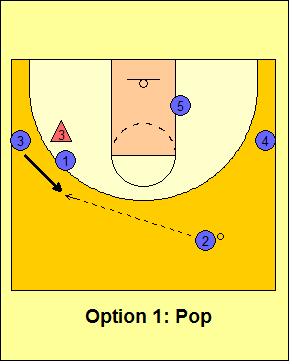


This is the part where you really need to drill your players, on how to read the defender off the downscreen. If the defender cuts underneath, then you pop out. You can then drive into the middle or shoot the mid-range, or shoot the 3-pointer. If the defender chases, then curl to the basket. If the defender jumps over the top to deny the pop, then backcut. If the defender cuts underneath and gets in a position to stop penetration, the screener rescreens for the flare cut.
It's also a great offense to use up some clock, you get good movement and there are other options you get use such as the post coming up to ball screen, it's an easy offense to fast break into. Really easy to teach, and something you can even add if you already do something like dribble-drive and you want something where players off the ball are moving more. I haven't seen the Kevin Boyle's Motion Offense DVD but I've heard that the rules are very similar.
Hope you all are having a great summer, it's hard to believe that there's only a few weeks left, the basketball season will be sneaking up on us pretty soon, enjoy the summer while you can.
I saw some club teams play a game the other day and one of the big things that I'm seeing lately is really bad one-on-one defense. Now, I know that in these summer games, not a lot of players and teams play much defense anyways, but that's besides the point, I'm seeing the same phenomenon in high school games too.
I think one of the major problems is that when we teach players that we want to force the ball baseline or middle (depends on your personal defensive philosophy), players translate that by opening up their body either to the baseline or to the middle of the floor, and then their check just blows by them. It's easy when we coach to then blame the help defender getting late. That's baloney, the ball is your man, square up and make the ball go lateral.
I got the phrase from Bobby Knight's Man-to-Man Defense DVD, Coach Knight talks constantly about never opening up your gate. The picture above is from Kemba Walker's game winner in UConn's win over Villanova from last season. The defender opens up and Kemba just attacks his technique and gets right into the lane for the game winning floater.
It's not about the help, obviously we want the ball to go to help, but we want the dribbler going east-west to help, not north/south. Once you open up your gate, you're inviting the offensive player to get to the hoop, irregardless if you're forcing baseline or middle to help.

An excellent read from GQ Magazine about a 22-year old who posed as a 16-year old in Odessa Texas, playing for the football-famous Permian Panthers before he got busted and the whole thing blew up in his face.
The story has a little of everything in it, I wouldn't be surprised if it ends up being made into a movie.

Going through the 2011 Nike Coach of the Year clinic manual and I want to quote coach Houston Nutt, head football coach for Ole Miss,
Players are looking for the following characteristics in a coach:
- They are looking for somebody they can trust.
- They are looking for somebody the can depend on.
- They want to have someone predictable and consistent.
- They also want to have someone committed to them.
- They don't really care how much football you know until they know how much you care.
I hear all the time from coaches that kids are too lazy these days - "... they don't wanna work... they're too busy chasing girls/boys... they lack discipline... they can't make a commitment... they don't know how to communicate anymore... they're too self-interested..." But what about we as coaches? Have coaches changed over time?
To be honest, I don't think kids or coaches have changed much at all over the times. The thing is, players will always find a way to let you down. They will be late, they will skip practice to be with their boyfriend/girlfriend, they will decide to take plays off, they will sometimes have an attitude. However, as a coach, you will always have to be perfect. You can't be late. You can't decide not to show up. You can't promise new practice jerseys, and then not come through. You can't have morning practices some weeks and night practices other weeks. You can't make a practice calendar, then change the dates at the last minute. It just has to happen once, just once, and you've lost all credibility and respect from your players. Players may not remember all the good things that we as coaches do for them, but they sure as heck remember everything you didn't do. It is our responsibility, as coaches, to practice what we preach and to teach players how to do it the right way all the time.
If you think about it, what players want from their coaches is rather simple really, they want you to be there for them. But it's easy to say, hard to do because it requires discipline. We ask it of our players, we sure as heck better live it as coaches? For example, take our summer lifting workouts, we go Tue/Wed/Thu from 1pm-2pm. It is voluntary as per the rules for all schools, but I'm there every session. We don't get that many basketball or football players out because of summer vacations, etc.. but there are several core players that are always there. They know that the date never changes, the time never changes, and it never gets canceled for the weather or for any other reason. Is it hard for me to be there each day? Yes and no. It is only 3 days of the week for 1 hour. But I'm on my summer holidays from teaching, and there are some days that I wished I could change it to 4-5pm so I can get in a round of golf, or 10-11am so I can meet a friend for lunch, or just to cancel it on a sunny day because I'd rather hang out at the beach. But I go each day because I believe it's important to our team that our players are working to get better, and because I've made a commitment to being there for them.
I know that there are extenuating circumstances, health issues, personal problems, work schedules, but understand that being a coach carries a big responsibility. A lot of people go into coaching and don't really understand or are ready for that kind of commitment. Coaching is sometimes as easy as just being there for your players, which can also be the hardest thing.
1-4 Across to Beat Matchup and Man Presses
Posted by bruchu Labels: Fastbreak and Early Offense, Presses and TrapsA lot of you probably have this press breaker in your arsenal against aggressive full court matchup or man presses, but if not, something interesting to consider. I was re-watching Billy Donovan's DVD on his Full Court Matchup Press the other day and one of the press breakers he talked about that gave them the most problems was the 1-4 across set. The wing players can really cause a problem because of the threat of the over the top pass,
What happens is if the defender, X5 or X3 in this case, is playing in a press coverage either inside or outside, they are highly susceptible to a quick v-cut and then a streak downfield for an over the top touchdown style football pass. You don't even need to v-cut, once the inbounder slaps the ball you basically break and you'll be wide open. If the inbounds is after a made basket, the inbounder can run the baseline and get an angle on either wing. If for some reason you can't make that football pass (bad timing, slow fowards, etc..), then O2 can cross screen for O1 and you can get into your regular press break.
Obviously after you burn the man-to-man press or matchup press a couple of times over the top, the defense will adjust by having the wings play over the top. They will still press the 2 inside players because the over the top throw is harder with the basket obstructing a high pass. But now you have a relatively open pass to the wing player, and your PG can use that to out-leverage the defender and streak as soon as the inbounds pass is made for the open pass,
So essentially, just by alignment, you have forced the defense out of a full press situation. If they decide to continue to pressure, they have to give each of your players a cushion. And by releasing all of your players down the court in a full sprint once the pass is made, you have effectively nullified their pressure. Sure, the X1 defender can still get up on your O1, they can try to trap with one of the other players, but you've allowed yourself the ability to get the ball in without pressure,
A Closer Look at the Bill Green True Matchup Zone
Posted by bruchu Labels: Man Defense, Zone DefenseThe last couple of days I've been busy putting together a defensive manual for our football team in preparation for the upcoming season and one of the big areas I was researching was the idea of pattern reading. You see, in football most teams that use a zone defense have gone away from straight spot dropping and match receiver routes instead. So, they align in a set zone, say a Cover 2, but then they read the receivers and their movements are dependent on what the receivers do. Now, it sounds like it would impossible to come up with a set of rules to match what the receivers do, but the thing is that receiver movements are highly predictable, because most passing routes are patterned and packaged together into concepts. Therefore, instead of just dropping into your "zone" area and covering grass, defensive backs are instead given a set of rules for a given receiver may do, and the defender reacts to that movement within their "zone" area. Turns out, in basketball, we can apply similar concepts.
In doing my research I came across a chapter in the book by Don Casey called "Own the Zone". It's a pretty good book going through the history of zone defenses in basketball. In the chapter on matchup zones, it talks about legendary high school Indiana coach Bill Green and how he came up with his true matchup zone. He and an assistant were watching a Purdue/Notre Dame football game and thought about creating a zone defense for basketball based on similar rules based on simple offensive player movements.
I had forgotten alot of what I've written in the past couple of years, so I went back through my blog and realized I actually wrote a pretty detailed article on the Bill Green 1-3-1 matchup zone (although I didn't credit it to Bill Green at the time) and it got my brain into overdrive again thinking about the different possibilities of matchup zones.
The original Bill Green matchup zone is based on the principle of dividing the court in 2 halves using the hoopline. The defenders are then assigned:
- a #1 defender on the point,
- a #2 defender takes the first offensive player on the left,
- a #3 defender takes the first offensive player on the right,
- a #4 defender takes the second offensive player on the left or right (the rover)
- a #5 defender takes anyone in the paint or right man high or low
What I did not cover in my original post was the basic matching principle that Bill Green uses, which is based on what the offensive player can do. For you football coaches out there, this will sound very familiar to robber coverage or 2-read. Basically, an offensive player with the ball can only do 1 of 3 things:
1. Shoot. Get a hand up.
2. Dribble drive. Slide and sag.
3. Pass.
An offensive player without the ball can only do 1 of 3 things:
1. Move and replace teammate.
2. Pick.
3. Flash to the basket.
Those are the only 6 things a player can do with or without the ball. On the first 2 with the ball, the defender reactions are universal, they are exactly same for any defense man or zone. On any pass and pick in any matchup zone, you will switch automatically every single time. So really, the rules for defender matchup movements are restricted to 2 movements, replace a teammate, and flash to the basket. All the players have to remember are their original rules. Any movement to replace a teammate is an automatic switch. Any flash to the basket is covered by the same defender. The most complicated movement is any flash or movement through the lane. In this case, the defender passes off their man to the #4 rover and they switch checks. Here are the base formations against offenses that will attempt to align against the matchup zone:


Having this base knowledge, defending flashes to the basket are stated as I wrote in the original article.
The weakness of the 1-3-1 matchup, is obviously the corners. Teams can overload to one side of the floor and now the defense has to break its rules to cover the 4 players on one side. 
In order to combat this problem, the #5 switches to take the corner man and #3 (or #2 if overload is on the left) takes the offensive player in the paint. 
If you are having a problem with the overload with a player in the corner, Bill Green has a 1-1-3 matchup which is stronger towards the baseline. Instead of using the hoopline as the divider, now there are 2 above the FT line and 3 below. If one of the 3 low players goes above the FT line, the #4 rover carries him above the divider.
I think the problem that most people who play a zone defense is that they just play the spots, they don't even attempt to matchup players. It's the same analogy as football defense, you can't just cover grass, you gotta cover receivers. Same in basketball, you gotta cover players.
For a good video that has a similarly type matchup zone system, check out Flip Saunders' DVD on the 1-2-2 Matchup Zone. Coach Saunders is currently the head coach with the Washington Wizards.
It's definitely the dog days of summer, and I'm trying to get in some reading and came across this great article about Coach Bobby Greco Jr. pursuing his dream to coach football. It's hard enough to coach with all of my faculties in working order, I can't even imagine how to do it from a wheelchair. But that is exactly what Coach Greco does everyday, as an assistant with St. John Fisher College.
Anyways, I was at a Kevin Eastman clinic over the weekend. It was a great clinic, a wonderful opportunity to talk X's and O's and I'm just putting together some notes and stuff from the clinic and to decide what I will post on next. It was a defensive clinic so most probably it will be related to defense. In the meantime, if you have some ideas, feel free to shoot me a message.

